Picture a family that just got a Brugada syndrome diagnosis for their teenager. The cardiologist mentioned an ICD might be needed someday, handed over a stack of pamphlets, and sent them home to figure out what “sudden cardiac arrest risk” actually means for daily life. That gap between diagnosis and daily reality is where most families get stuck. I spend my time testing gadgets and cutting through marketing noise, and an AED is, at its core, a gadget with a job to do. So let’s treat it that way and figure out what actually matters.
What an AED Actually Does
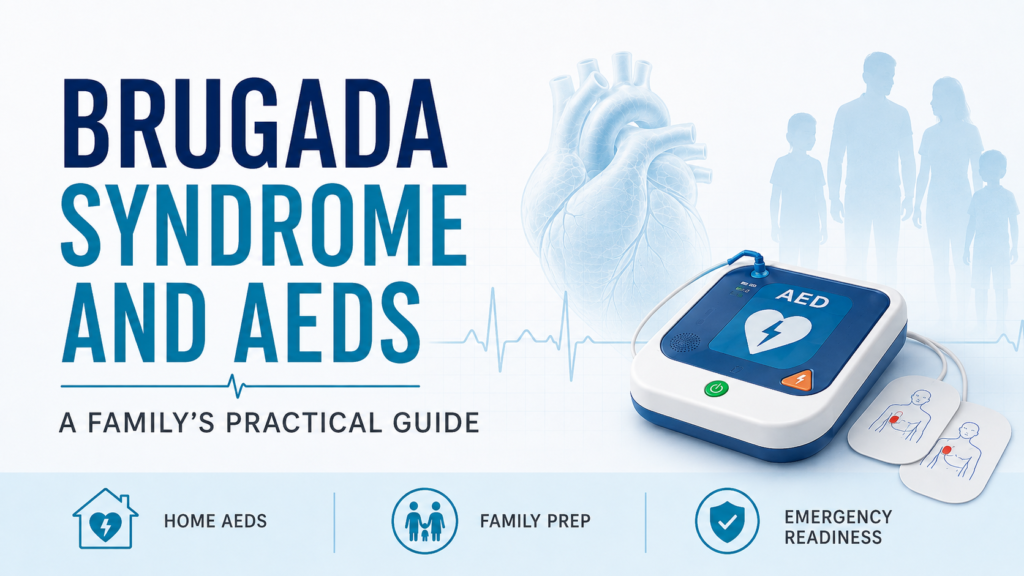
An automated external defibrillator reads your heart’s electrical rhythm through pads stuck to your chest. If it detects a rhythm that a shock can fix, like ventricular fibrillation, it delivers that shock to try to reset the heart back to normal. If it doesn’t detect a shockable rhythm, it won’t shock. That’s the whole design philosophy: let the machine make the call so a scared bystander doesn’t have to.
For Brugada syndrome specifically, this matters because the syndrome is an inherited heart rhythm disorder that raises the risk of exactly the kind of dangerous arrhythmia an AED is built to catch [1][2]. But here’s what an AED is not: it’s not a diagnostic tool, not a treatment plan, and not a substitute for whatever your electrophysiologist recommends, including an implantable cardioverter-defibrillator if you meet the criteria for one [3].
Think of it as a fire extinguisher. You still need the smoke detector, the sprinkler system, and the fire department. An AED is one layer in a bigger safety plan.
Why Brugada Families Consider Home AEDs
Brugada syndrome carries genuine risk of sudden cardiac arrest, and that risk doesn’t wait for business hours [3][1]. Families who’ve been through a diagnosis often describe the same feeling: the danger doesn’t feel abstract anymore once you know it has a name. That’s usually the moment a home AED enters the conversation.
Research has actually looked at this directly. A major clinical trial published in the New England Journal of Medicine examined home use of AEDs for people at risk of sudden cardiac arrest and found that adding a home AED to a response plan that already included CPR training didn’t significantly improve survival compared to relying on CPR training alone [4]. That’s a genuinely important, if uncomfortable, finding. It doesn’t mean AEDs don’t save lives. It means the picture is more complicated than “buy the device, problem solved.”
A separate analysis using data from the Cardiac Arrest Registry to Enhance Survival looked at both effectiveness and cost-effectiveness of AEDs placed in private homes, digging into whether the investment translates into meaningfully better outcomes for the household [5]. If you’re weighing a purchase, that’s the kind of study worth asking your cardiologist about directly, because the answer isn’t the same for every family or every risk profile.
Who Actually Benefits Most
Not every Brugada patient falls into the same risk bucket, and that distinction changes the AED conversation completely. Some patients already qualify for an ICD, a device implanted under the skin that monitors the heart continuously and shocks automatically from the inside without anyone needing to be present to apply pads [3]. If you’re in that category, a home AED plays a different, more limited role.
Where a home AED gets more attention is with children, adolescents, and young adults who carry Brugada risk but don’t yet meet the criteria for an ICD [6]. A structured review of this exact population made the case that home AEDs deserve serious consideration as an interim safety net for younger patients who are still being monitored and risk-stratified [6]. That’s a meaningfully different scenario than an adult who already has a device doing the job around the clock.
- Patients with an existing ICD: an AED is a backup, not a primary line of defense.
- Younger patients not yet meeting ICD criteria: home AED access may fill a real gap during that waiting period [6].
- Extended family members without a formal diagnosis: genetic screening and a cardiologist’s guidance should come before any device purchase [7].
- Households with frequent visitors or caregivers: everyone who might respond needs basic training, not just the person who bought the device.
What To Actually Look For in a Home AED
I test consumer gear for a living, and the instinct to compare spec sheets kicks in fast with any device category. AEDs resist that instinct a little, because the FDA regulates them as medical devices, which narrows the field compared to, say, smart plugs. Still, a few practical factors are worth your attention.
Voice prompts matter more than most people expect. In an actual emergency, adrenaline wrecks your ability to read instructions off a small screen. A device that talks you through pad placement and timing, step by step, out loud, reduces the room for panic-driven mistakes.
Battery and pad shelf life matter too. These aren’t things you can “check” during a crisis. You want a maintenance routine, a calendar reminder, and a habit of actually looking at the readiness indicator instead of assuming it’s fine.
Ask your cardiology team directly about training resources. The SADS Foundation, which focuses specifically on sudden arrhythmia death syndromes including Brugada, maintains guidance and FAQ resources on AED use that go beyond what you’ll get from a product manual [7]. That’s a better starting point than a retailer’s marketing copy, full stop.
The Training Gap Nobody Talks About
Owning an AED and knowing how to use one under stress are two very different things. This is the part of the equation that tech reviews tend to skip, because it’s not a spec you can put in a comparison chart.
Research on public-access defibrillation has shown that survival after AED use in real emergencies depends heavily on how quickly bystanders act and how confidently they respond [8]. A device sitting in a closet does nothing. A device your family has actually practiced with, even in a basic run-through, changes the odds. Mayo Clinic’s guidance on AEDs echoes this point directly: knowing when and how to use one is part of the equipment, not an optional add-on [9].
If you’re a tech-forward household already comfortable with smart home routines and automation, you have an advantage here that a lot of families don’t. You’re used to setting up systems, testing them, and building habits around them. Apply that same instinct to your AED. Schedule a family practice session. Put a reminder on the calendar for pad and battery checks. Treat it less like a purchase and more like a system you maintain.
Where This Fits Into a Bigger Plan
An AED is one piece of a Brugada management plan, not the whole plan. Genetic counseling and screening for close relatives matters, since Brugada syndrome is inherited and other family members may carry the same risk without knowing it [1][2]. That conversation belongs with a geneticist or electrophysiologist, not a product review.
Regular follow-up with a cardiologist who understands inherited arrhythmia syndromes matters just as much. Treatment approaches for Brugada have shifted over time as research has advanced, and staying current with your specialist means your risk assessment and device recommendations stay current too [3]. An AED bought five years ago based on outdated guidance isn’t doing you any favors if your family’s risk profile or treatment options have since changed.
I’ll say this plainly: don’t let a device purchase substitute for the harder, slower work of building a full care plan. It’s tempting to buy something concrete when you’re dealing with an invisible risk. But the AED works best as backup to expert care, not instead of it.
Frequently Asked Questions
Does having Brugada syndrome mean I automatically need an AED at home?
No. That decision depends on your specific risk level, whether you already have an ICD, and your cardiologist’s assessment [3][6]. Some patients not meeting ICD criteria may benefit from home AED access as an interim measure, particularly younger patients [6].
Do home AEDs actually improve survival for at-risk patients?
The evidence is mixed. One major trial found that adding a home AED didn’t significantly improve survival beyond CPR training alone in a general at-risk population [4], while other analyses point to specific subgroups, like younger Brugada patients, where the calculus may differ [6]. Talk to your specialist about where you fall.
Can an AED replace an ICD for someone with Brugada syndrome?
No. An ICD is implanted and monitors the heart continuously, while an AED requires a bystander to apply it during an event [3]. They serve different roles and aren’t interchangeable.
Where can families get reliable guidance on AED use for inherited arrhythmia conditions?
The SADS Foundation offers AED resources and FAQs specifically geared toward families dealing with sudden arrhythmia death syndromes [7], and Mayo Clinic provides general guidance on who needs an AED and how to use one [9]. Both are better starting points than product marketing.
Your Next Step
If your family is navigating Brugada syndrome and weighing whether a home AED belongs in your emergency plan, don’t make that call alone. Bring the studies mentioned here to your next cardiology appointment and ask directly where your specific situation falls. A device is only as good as the plan built around it, and that plan starts with a conversation, not a purchase.
Sources
- Brugada Syndrome – StatPearls – NCBI Bookshelf (ncbi.nlm.nih.gov)
- Brugada Syndrome – Cardiology – Merck Manual Professional Edition(merckmanuals.com)
- Treatment of Brugada Syndrome in 2023: Know Where You Come From to Know Where You Are Going (ahajournals.org)
- Home Use of Automated External Defibrillators for Sudden Cardiac Arrest(nejm.org)
- Effectiveness and Cost-Effectiveness of Automated External Defibrillators in Private Homes: A Report From the Cardiac Arrest Registry to Enhance Survival – Erasmus University Rotterdam (pure.eur.nl)
- State-of-the-Art Review The Case for Home AED in Children, Adolescents, and Young Adults Not Meeting Criteria for ICD (sciencedirect.com)
- AED Resources and FAQ – SADS Foundation (sads.org)
- Survival After Application of Automatic External Defibrillators …(pmc.ncbi.nlm.nih.gov)
- Automated external defibrillators: Do you need an AED? (mayoclinic.org)
Researched from 9 vetted sources · average source authority DR 87