
Picture a family that’s just learned a diagnosis: Brugada syndrome. The name alone sounds scary, and the flood of medical terms that follows can feel worse. Somewhere in that conversation, a doctor mentions an AED. What is an AED, exactly, and why does it matter so much for a family managing a genetic heart rhythm condition? So let’s break this one down in plain terms, because this is a device where understanding actually changes outcomes.
What an AED Actually Does
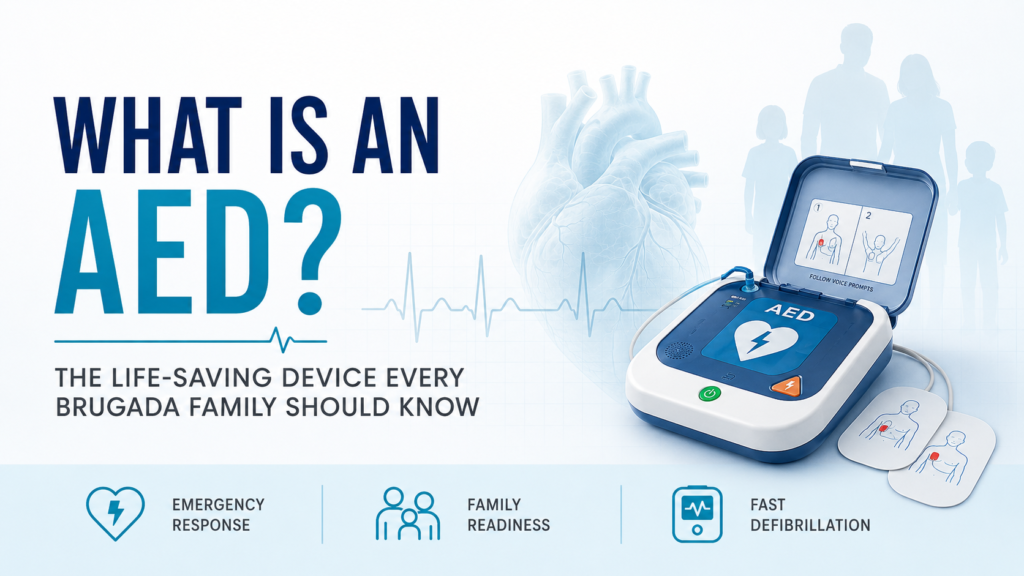
An AED, short for automated external defibrillator, is a portable device that reads a person’s heart rhythm and delivers an electric shock when it detects a dangerous, shockable rhythm like ventricular fibrillation. It’s built to be used by regular people, not just paramedics. You attach two pads to the person’s chest, the device analyzes the heart’s electrical activity on its own, and it tells you, often through voice prompts, whether a shock is needed.
That automation is the whole point. You don’t need to know how to read an EKG or make a clinical judgment call. The machine does that part. If it detects a rhythm that a shock can fix, it charges and either delivers the shock automatically or tells you to press a button. If the rhythm doesn’t call for a shock, it won’t let you deliver one. That safeguard is why these devices ended up in airports, gyms, and schools instead of staying locked inside hospitals.
For a family dealing with Brugada syndrome, this matters because sudden cardiac arrest from the condition often happens with no warning at all. There’s no slow decline, no obvious buildup. A device that can act within seconds, before emergency responders even arrive, closes a gap that would otherwise be fatal.
Why Brugada Syndrome Changes the Calculation
Brugada syndrome is a genetic condition that disrupts the heart’s electrical signaling, raising the risk of sudden, dangerous arrhythmias, sometimes in people who otherwise look and feel completely healthy [1]. It’s classified as a channelopathy, meaning the problem sits in the ion channels that control the heart’s electrical rhythm rather than in the heart’s physical structure [2]. That’s part of what makes it so unsettling for families: a structurally normal heart can still be at risk.
Management typically involves specialist cardiology care, and for higher-risk patients, an implantable cardioverter-defibrillator, or ICD, is often the recommended treatment [3]. An ICD lives inside the body and can respond to a dangerous rhythm automatically, day or night, without anyone else in the room. That’s a very different tool than a home AED, which needs another person present to retrieve it, apply it, and let it work.
This is where families sometimes get the picture wrong. An AED isn’t a substitute for an ICD when an ICD is medically indicated, and it’s not a replacement for genetic screening across the family or ongoing specialist follow-up. Think of it as a bridge device, something that can respond in the gap before paramedics arrive, or in cases where a person hasn’t yet been evaluated for an ICD, or for family members who haven’t been tested and don’t know their own risk yet.
Does a Home AED Actually Save Lives?
This is the question every family in this situation eventually asks, and it’s a fair one. Research specifically on home AED use gives a nuanced answer.
A major clinical trial on home defibrillator use for people who’d already survived a heart attack found that adding a home AED didn’t significantly improve overall survival compared to relying on standard emergency response. This is largely because many cardiac arrest events in the home happen without anyone present to use the device, and because a large share of at-home arrests aren’t shockable rhythms to begin with [4]. That result surprises a lot of people, and it should temper any assumption that simply owning a device guarantees a better outcome.
At the same time, other data paints a more encouraging picture for the moments when someone actually is nearby and a shockable rhythm is present. A review of automatic external defibrillator use found meaningfully improved survival when a shock was delivered promptly by a bystander before emergency crews arrived, compared to waiting for professional responders alone [5]. And a cost-effectiveness analysis of AEDs placed in private homes found the devices could be effective within realistic budget ranges, particularly for households at elevated cardiac risk [6].
Put those two threads together and you get a device that’s genuinely valuable, but not magic. It’s most useful when someone is present to use it, when the rhythm involved is shockable, and when it’s paired with real training and a plan for how the household would respond in an emergency. That’s exactly the profile of a lot of Brugada families, where household members are aware of the risk and can be trained in advance.
What a Family Should Weigh Before Buying One
If you’re a tech-savvy household already comfortable with smart home gear, adding a home AED to your emergency plan probably feels like a natural extension. But this isn’t the same as picking a smart speaker. A few things are worth thinking through first.
- Who’s home, and when. An AED only helps if someone capable of using it is present during an event. If the at-risk person is frequently alone, that changes the calculation significantly.
- Training matters more than the device spec sheet. Everyone in the household who might use the device should know where it’s stored and how it works before an emergency, not during one.
- An AED supplements, it doesn’t replace, medical guidance. Specialist cardiology follow-up, family genetic screening, and an ICD evaluation for higher-risk patients should come first [3].
- Placement and maintenance count. Pads and batteries have a shelf life, and a device that’s expired or stored somewhere inconvenient in a crisis isn’t much use to anyone.
The SADS Foundation, an organization focused on sudden arrhythmia death syndromes, provides guidance specifically aimed at families navigating these decisions, including how to think about AED access and awareness at the household level [7]. That’s a genuinely useful resource if you’re early in this process and trying to figure out what steps come first.
How AED Technology Has Gotten More Accessible
One thing I can speak to directly is how much friction has been engineered out of devices that used to require professional training. AEDs are a great example. Modern units use voice prompts that walk a bystander through every step, from pad placement to standing clear before a shock. The analysis happens automatically, the device won’t let you shock a rhythm that doesn’t need it, and many units now include visual cues alongside audio for people who might be too panicked to process spoken instructions clearly.
That accessibility push mirrors what’s happened across the smart home world, where devices that once needed a specialist to install now set up in minutes. The stakes are obviously different here. But the design philosophy, removing the burden of expertise from the user in a high-stress moment, is the same one that’s made Matter-standard smart home gear easier to adopt at scale.
For a Brugada family, that accessibility is genuinely good news. It means the barrier to having a usable AED in the home isn’t a steep learning curve. It’s cost, placement, and making sure everyone in the household actually knows it’s there.
Building AED Readiness Into Your Household Plan
If your family is managing Brugada syndrome, treat the AED as one part of a broader emergency plan rather than a standalone purchase. That plan should include your cardiologist’s specific recommendations, a clear answer on whether an ICD has been discussed for the affected family member, and a household conversation about where a device would be stored and who’s trained to use it.
It’s also worth talking honestly about the research findings above. A home AED is not a guarantee, and the data on general at-home cardiac arrest survival makes that clear [4]. But for households where someone is reliably present and trained, the survival benefit of prompt bystander shock delivery is real and measurable [5]. Knowing which scenario actually describes your household helps you make a decision grounded in your real situation, not in marketing copy or fear.
Frequently Asked Questions
Do I need a doctor’s prescription to buy an AED?
Requirements vary by device and by location, and this is a question worth asking your cardiologist directly, since guidance can be specific to your medical situation and your local regulations.
Can an AED replace an ICD for someone with Brugada syndrome?
No. An ICD is implanted and can respond to a dangerous rhythm automatically without another person present, while an AED requires someone nearby to retrieve and apply it. For patients who meet criteria for an ICD, that device is generally the primary recommended treatment, with a home AED serving as an additional layer rather than a substitute [3].
How long do AED batteries and pads last?
Shelf life varies by manufacturer and model. Whatever device a family chooses, checking expiration dates on pads and batteries on a regular schedule is essential, since an expired unit may not function when it’s needed most.
Is a home AED worth it if someone in my family has Brugada syndrome but hasn’t had a cardiac event?
This is a conversation to have with a cardiologist or electrophysiologist familiar with the person’s specific risk profile. Family genetic screening and specialist evaluation should come first, since they determine whether an ICD is recommended and how urgent the overall risk picture actually is [3][2].
Where to Go From Here
An AED can be a genuinely valuable piece of an emergency plan for a Brugada syndrome family, but it works best as part of a bigger picture that starts with your cardiology team, not with a product page. If you’re at the beginning of this process, your first move should be a direct conversation with a specialist about screening, ICD evaluation, and whether a home AED fits your household’s specific circumstances. From there, resources like the SADS Foundation can help you think through the practical side of AED access and family awareness [7]. Understanding what is an AED and how it fits into a broader safety plan is the first real step toward making a decision that actually protects the people in your home.
Sources
- Brugada Syndrome – StatPearls – NCBI Bookshelf (ncbi.nlm.nih.gov)
- Brugada Syndrome – Cardiology – Merck Manual Professional Edition(merckmanuals.com)
- Treatment of Brugada Syndrome in 2023: Know Where You Come From to Know Where You Are Going (ahajournals.org)
- Home Use of Automated External Defibrillators for Sudden Cardiac Arrest(nejm.org)
- Survival After Application of Automatic External Defibrillators …(pmc.ncbi.nlm.nih.gov)
- Effectiveness and Cost-Effectiveness of Automated External Defibrillators in Private Homes: A Report From the Cardiac Arrest Registry to Enhance Survival – Erasmus University Rotterdam (pure.eur.nl)
- AED Resources and FAQ – SADS Foundation (sads.org)
Researched from 9 vetted sources · average source authority DR 87